Delivering PGCE courses ‘remotely’ over the past three months has certainly presented challenges at times, but many of these have created opportunities in turn. There has been a steep learning curve for providers and trainees alike, but increasing use of platforms such as Zoom and Blackboard collaborate have yielded some great results in recent weeks.
Working within the partnership during the pandemic
Providing PGCE trainees with a balanced and broad diet of training inevitably relies to some extent on quality inputs from practitioners in our partner schools, especially when visiting speakers have an area of specialism in their own subject. Enter Ben Scott, Professional Mentor and Teacher of History & Politics at Wellington School in Timperley. Ben and I started our collaboration back in January, after I approached him to deliver a day of teaching at UoM focusing on A-Level History and Politics. His brilliant session back in January was to be followed by a session at UoM in early June in which trainees would showcase their A level skills and present bespoke lessons on a variety of A- level History topics, ranging from the Russian Revolution to Second Wave feminism in 1970s. America.
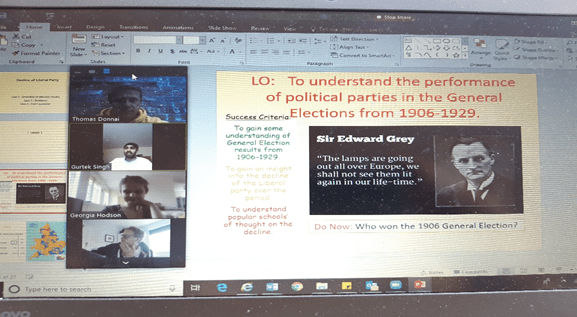
The closure of University buildings in March meant that the session needed to be redesigned and delivered on Zoom. Despite our initial misgivings, the day turned out to be a triumph of sorts, as trainees delivered and critiqued their A- level lessons to Ben, myself and other trainees, with Ben providing specialist feedback.
PGCE Historians Gurtek Singh and Georgia Hodson talk us though their lessons on General Elections between 1906 -1929
Ben Scott summarises the collaboration and its outcomes below: As Professional Mentor at Wellington I’ve sorely missed the interaction with trainees during lockdown and from start to finish these presentations provided a great opportunity to re-focus my critical eye. I was hugely impressed with the quality throughout with the small group Zoom sessions running much slicker than initially expected. It was clear that a great deal of thought had been put into each presentation as all trainees without exception were able to outline a clear rationale in terms of both pedagogy and content. Screen-sharing meant they were able to explain their rationale with confidence, making giving specific feedback straightforward. Exam specifications had been researched in detail, there were clear references to exam technique, scaffolding activities, differentiation, academic rigour and placing the lessons within the ‘big picture’ of the 2 year course. It was also really pleasing to see lots of reference to metacognitive strategies, something which we’ve been working hard on at embedding in our practise at Wellington. Undoubtedly, the sessions were a real success, it was great to see the progress the trainees had made since my session back in January and it was evident that the trainees had developed into confident A Level practitioners.
Joe Kilner and Kate McCoubrey talk us through their lesson on Second Wave feminism in the 1970s
What next?
Whilst it is safe to say that most trainees, tutors and mentors prefer ‘face to face’ teaching to other alternatives, the collaboration made it clear that the use of online platforms such as Zoom can work brilliantly too. Importantly, trainee feedback made it clear that ‘small group’ presentations work just as well remotely, with some notable advantages. Kate and Joe cited a ‘complete lack of nerves’ and ‘relaxed atmosphere’ as benefits of the activity, whilst Gurtek stressed that ‘quality feedback from and expert in A-level History [Ben, not me!] was an advantage, going on to say that ‘I actually prefer doing this type of presentational activity online’.
Ben and I will be delivering a presentation on our collaboration this year at the forthcoming Partnership Showcase on July 3rd, and are already planning follow up work with the 2020/21 cohort.
Ongoing uncertainties around when face teaching will begin mean that Zoom, and similar platforms may yet play a significant part in the delivery of our PGCE programmes. In working creatively and collaboratively with our partners, we at UoM can ensure that our ITE provision continues to be outstanding.
Visits to countless schools over the past 3 years, and scrutiny of countless curricula seem to confirm one thing to me: we don’t ‘do’ LGBT History very well in schools. Of real concern is that for most students, ignorance is reinforced by the near absence of LGBT History from the National Curriculum (it is left to forward thinking departments to improvise and ‘weave in’ LGBT+ histories into their curricula). There are , therefore, missed opportunities for a richly diverse reading of the past, of which LGBT+ History is an excellent and important example. Past attitudes to human sexuality and gender are an obvious starting point for departments wishing to make their teaching of History more inclusive. Most standard KS3 & KS4 schools history textbook endorse this deafening silence with, at best, a handful of tokenistic insights attempting to cover, amongst others, Women’s History and Black History. The ignorance is further buttressed by the lack of training for our new teachers on how to make marginalised groups visible in the History curriculum.
However, most History teachers (certainly in my experience) agree that an inclusive reading of the past in not only academically sound (i.e. providing a more reliable history) but also provides students with excellent preparation for adult life, challenging harmful stereotyping and contextualising and appreciating our societies rich diversity.
Why doesn’t this always happen then?
Practical Professional Problems:
As is often the case, the two pressing factors seem to be time and expertise. Teachers’ professional lives are incredibly busy and the job of writing and resourcing good schemes of work is a big one.
The question of expertise is also significant. Many teachers (including my trainees) sometimes feel that they are ‘imposters’ when addressing an area of History, they have little experience teaching. This is a proper and common concern, especially when considering what might be seen as ‘sensitive’ history topic. The desire to ‘play it safe’ often leads to a type of pedagogic conservatism which often looks like repeating or refining what others in department do or have done. Put bluntly, teachers often don’t feel confident in addressing LGBT+ History and are conscious of being clumsy or insensitive in their planning and delivery.
Currently this problem is further aggravated by the limited number of courses available ( undergraduate and postgraduate) that adequately cover the teaching of LGBT History in the secondary school setting. This means that most if not all current and trainee History teachers have little or no knowledge of LGBT+ History or access to such reading of the past, its bespoke methodology, nomenclature and historiography.
Therefore, trainees often arrive on PGCE programmes share with a lack of insight and need support in developing their thinking on approaches to teaching LGBT+ History.
Political ‘Narrowing’ of the History Curriculum
The content for GCSE History has been broadened significantly since the new specifications were introduced in 2017, meaning that many schools are now opting for a two-year Key Stage 3 and electing for a three year GCSE programme. This puts extra pressure on departments to ‘cover’ significant tranches of the past, and means that many History departments are being forced to narrow, not grow their curricula. The price of a performative and results – driven culture in education is sometimes a thin and watery curriculum.
In an attempt to improve this aspect of my own PGCE History programme, I contacted the LGBT Foundation back in September, and spoke with Sue Sanders (Chair of School Out(UK) and the best established LGBT+ Education Charity) about accessing expertise in the area. She put me in touch with Dr Jeff Evans, Research Fellow at John Moores University, and founder of the ‘Outing the Past’ festival, and active campaigner for LGBT+ and human rights for the past 40 years. Jeff is one of the most prominent voices in the drive to bring an inclusive reading LGBT History to our classrooms and our collaboration thus far has been one of the highlights of the PGCE History programme.
The notion of expertise cropped up immediately when Jeff and I mapped out the session in mid-September. Jeff pointed out that, where LGBT History is concerned, expertise does often not exist in schools and the challenge of diversity proponents to place the PGCE Historians in a position where they would become the experts. The theme of teacher agency and taking control of curriculum development came up again and again when Jeff delivered his inspirational session in January. What follows is a summary of Jeff’s work with the PGCE Historians at the University of Manchester and some ideas for where we’re planning to take this collaboration next.
The aims of the session were threefold:
1] To provide the students with a definition for LGBT History and to consider what it might look like in a classroom context
2] To explore how we can teach LGBT History and the potential obstacles
Jeff’s session began with a quotation that immediately stimulated a lively discussion and focused the PGCE students’ thinking. Jeff’s definition of inclusive history is as follows:
“Any and all readings of the past that lights-up those areas of our past (i.e. previously marginalised or excluded groups from ‘official’ history) are essential to gaining a more inclusive, accurate and thereby more relatable reading of our collective past.”
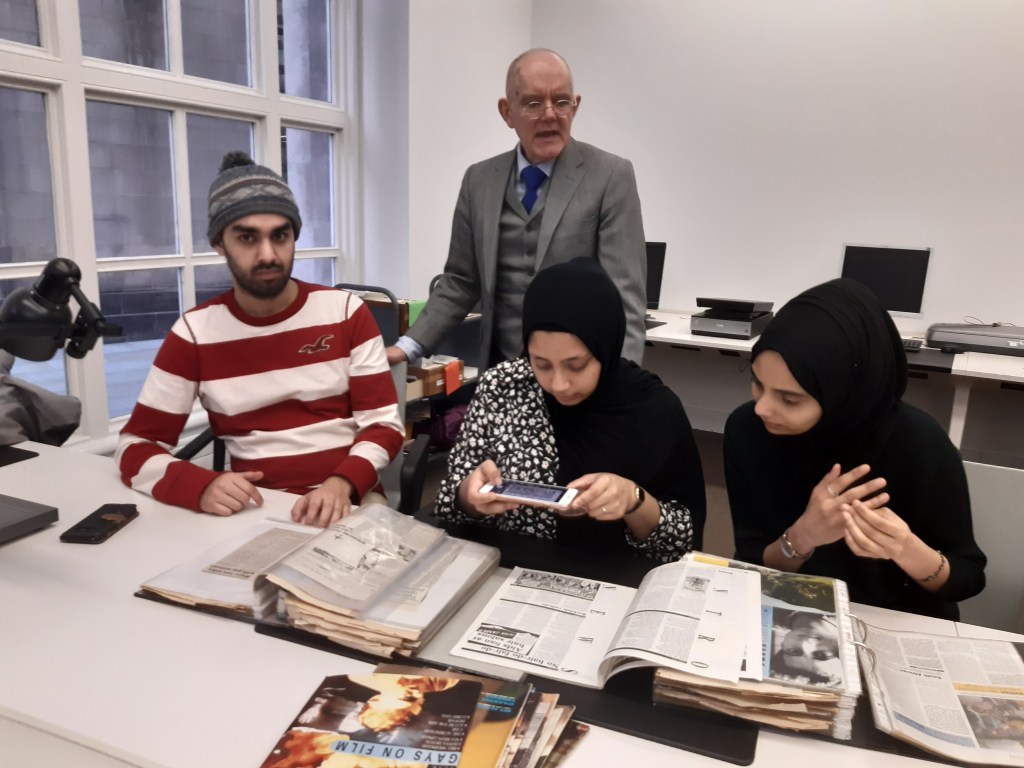
Once we had agreed a loose definition LGBT+ History and had completed a timeline activity exploring LGBT History from a chronological perspective, discussions about the current state of LGBT History teaching in schools followed. LGBT+ histories are often hard to locate because they are frequently entirely absent from schools’ schemes of work. The importance of oral testimony and archive material are clearly key here, and this led us to fieldwork location one: the archives at Manchester’s Central Library.
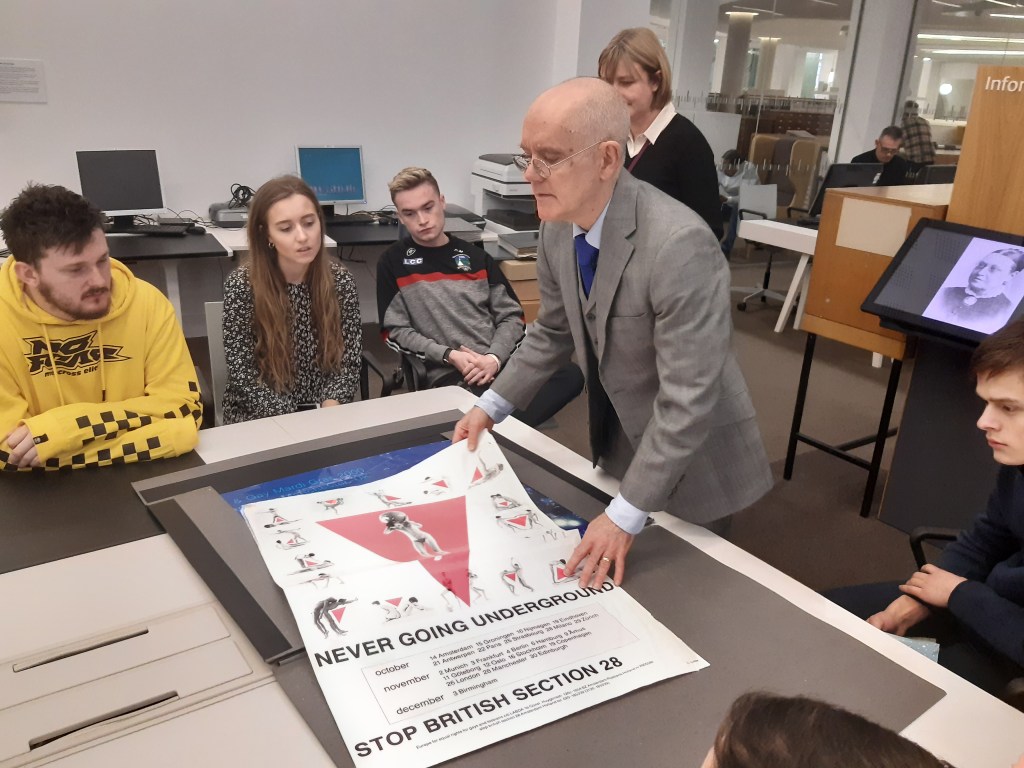
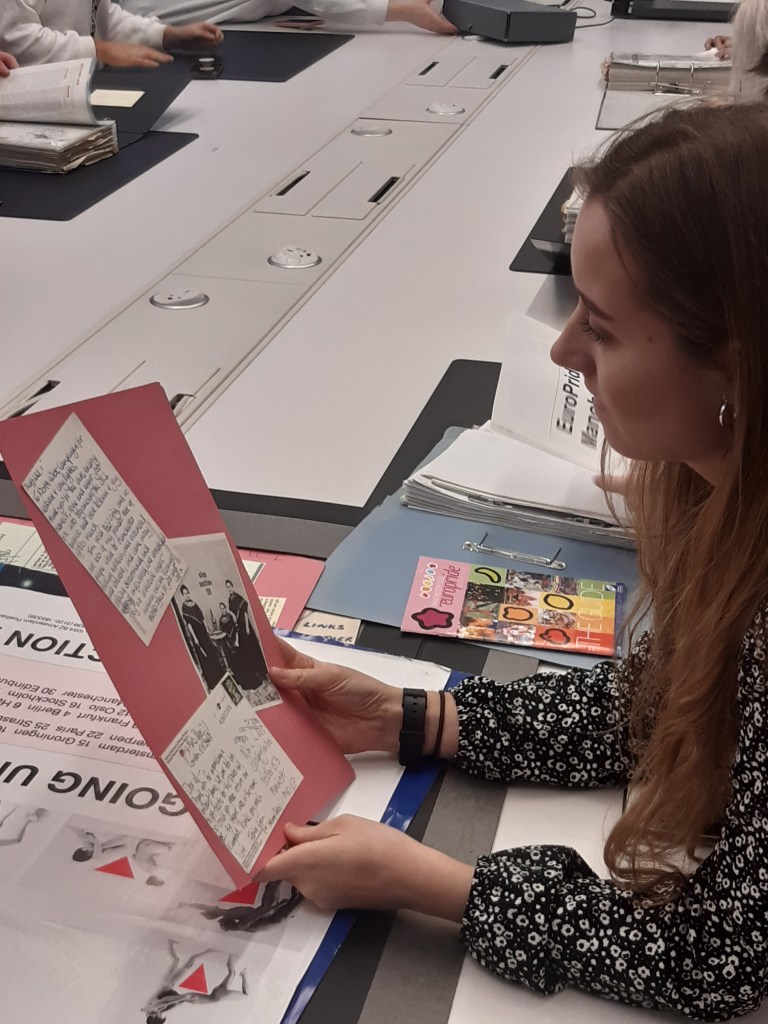
The PGCE History trainees spent time exploring a range of primary source material and considered how the source material could be placed at the centre of the lessons they were to devise. Excerpts from local and national press over the past 30 years helped to give the trainees an idea of the prevalence of homophobia in the mainstream media and to also chart changing views over time, and many of the trainees opted to use selected excerpts as the starting points of their lessons. In looking at contemporary examples of opposition to and protest against Section 28, trainees were able to identify some excellent source material to bring into the classroom.
Section 28, a piece of legislation introduced by Margaret Thatcher’s Conservative government, stated that local authorities were not allowed to “intentionally promote homosexuality or publish material with the intention of promoting homosexuality”. Many of the students were unaware that such legislation existed so recently and were also surprised by the openly hostile nature of pieces in national broadsheets and tabloids towards he LGBT community. The value of working with source material like this soon became evident. The impact of touching and working with these artefacts stands in stark contrast to what many teachers are forced to do: mining source material from the internet. The impact and relevance of each piece of history was heightened and I’m now considering starting the PGCE History course with an exploration of the many archives that Manchester has to offer. Every trainee left Central Library with a selection of 2-3 sources that they would then form their lessons around.
Next stop was the People’s History Museum for more exploration of the archives. The trainees unearthed a rich seam of material and lesson plans were further refined and discussed. We were treated to a tour of the archives unearthed a couple of gems, including the 1945 Labour Party Manifesto and a variety of brilliant primary sources that helped illustrate ‘hidden’ stories from with the LGBT community in Manchester.
Follow up, feedback and next steps for the collaboration
Back at University in the afternoon, work commenced on the trainees’ lesson plans; the range of foci was astonishing and the incorporation of source material from both libraries led to some outstanding discussion and debate. The lessons won’t necessarily serve as a cohesive, chronological scheme of work, but rather as a series of ‘stand alone’ lessons exploring different aspects of LGBT History. We’re looking forward to sharing our resources with the history teaching community on ‘The Classroom’ website when our materials go live in February: http://the-classroom.org.uk/category/the-materials-to-use/by-subject/History/schools-out-history-lessons/
Trainee evaluations established that many of the desired outcomes had been met, and provided further food for thought in shaping the session in years to come; it is my intention to enshrine Jeff’s session in the History PGCE curriculum and to continue to modify it over the years. Some soundbites on the positives are given below:
‘Amazing opportunity to look at archives I previously would not have seen’.
‘Mighty inspiring and eye opening. I really hope I can implement some aspects of this into the classroom! ‘
‘I thoroughly enjoyed this session and I am looking forward to implementing what has been learnt’.
‘Now have a a new understanding of how important inclusion of LGBT content can be for some students in term of representation and visibility’
I’ve now got the knowledge of where to find LGBT resources locally’
Next steps are clear from an examination of the feedback – see the ‘even better ifs’ below:
‘Lesson planning was a bit stressful; I feel like I need more contextual knowledge’.
‘It’s difficult to really know how to implement different methodologies with clear examples but that’s just the fault of the lack of resources’.
’Would have enjoyed some more time with Jeff on planning lessons and also on theory and historiography’
Inclusive History and curriculum building has been one of the prominent issues the PGCE Historians have been working on this year, and whilst none of the trainees profess to be the finished article, I’ve seen them come a long way since September. If nothing else, they are now asking the right types questions of the existing curricula they teach, and are thinking about how to make their own teaching of History more inclusive and more relevant to their students.
Have we created ‘experts’? That’s debatable. Have we prepared the trainees to bring new knowledge, insights and perspectives to the teaching of LGBT History? Absolutely. Here’s to continuing work with Jeff and the University of Manchester PGCE History course.
Thinkpiece 3: How do History NQTs view lesson observation?
As a former Assistant Head and Professional Mentor, and more recently a course leader on a University based PGCE programme, observing lessons has been integral to helping me form judgements about the progress of ITE participants over the past 10 years. Lesson observation, as O’Leary (2013) observes, is a ‘ubiquitous mechanism’ and is the principal means of assessment of trainee teachers. I’ve always been interested in its efficacy, particularly where teacher development is concerned. It’s difficult to imagine a system of assessment for ITE participants that does not include a significant number of formal and informal observations for trainees, but there seem to be lacuna in the body of knowledge surrounding how trainees view observation and from whom they gain value in the process.
It is only really since the emergence of New Labour in the 1990s that lesson observation in schools has become ‘universal’ in secondary schools, yet in the intervening 23 years, little research has been undertaken about trainee perceptions of its impact, particularly in the field of History education. Recent research from the EEF teacher observation project (2017) found no evidence that teacher observation improves combined GCSE English and maths scores, yet little or no work exists that explores the impact of lesson observation, and the attendant perceptions of beginning History teachers about the value and impact of lesson observation in its many forms.
Experience of working as a lesson observer in both school and university contexts encouraged me to explore lesson observation in more depth, and the following graphics and discussion, taken from work on my MA dissertation, explore the views of a cluster of 25 History NQTs who were based in North West schools in the 2017/18 academic year. As a History PGCE course leader I feel strongly that finding out more about the subject is critical; revisions to the Ofsted framework school inspection and for the inspection of ITE mean that capturing the views of beginning teachers are more important than ever. Are current approaches to lesson observation perceived to be effective? Which types of observation are viewed as the most impactful and valid? Whilst this small scale study provided no conclusive answers, the following graphics provide some interesting food for thought and will form the basis on ongoing research.
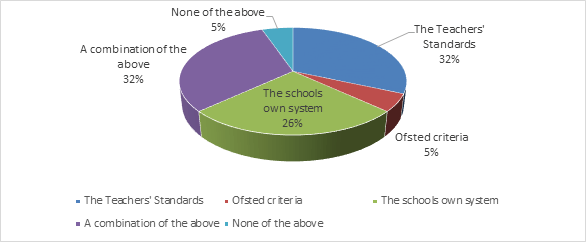
Question 1: For formal observation, does your school use..’
It was interesting to note the range of approaches employed by schools to lesson observation and the findings from this question formed the basis for further questions about the perceived value of each. Incidentally, the grading of individual lessons appears to be historic practice and is all but obsolete; none of the 25 respondents reported lesson grading in their schools.
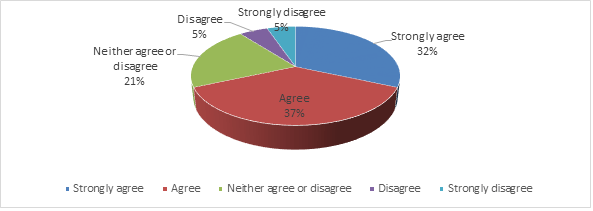
Question 2: ‘Formal lesson observation has helped to improve my teaching skills’
The move away from grading lessons may explain to some extent why perceptions of formal observations were positive in general; perhaps the move away from ‘performative’ style observations and an increasing focus on ‘developmental’ feedback helps to explain such perceptions. Responses to the follow-up questions in semi-structured interviews revealed generally positive perceptions around the extent to which formal observation improves teaching skills and helps NQTs to make progress against the Teachers’ Standards. It was interesting to see the theme of collegiality recur in these interviews and this might go some way to explaining why perceptions of interviewees was generally very positive where formal observation is concerned.
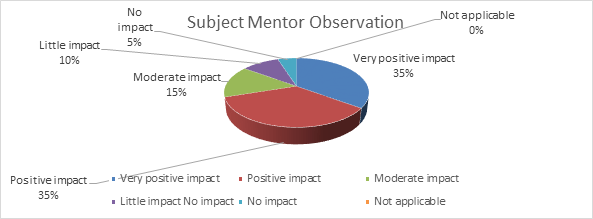
Question 3: How do you judge the impact of observation by your Subject Mentor?
I was fascinated by the response to this, and the following question. The depth of approval for a subject specialist observer was clear.
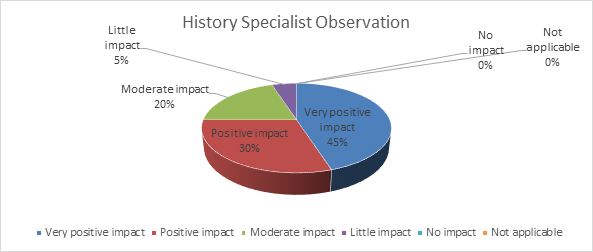
Question 4: How do you judge the impact of observation from a History specialist?
In fact, observation by a subject specialist (Figures 9 and 10) received the highest level of approval of all the different observation types explored. Clearly, subject specialist observations for beginning History teachers offer a unique opportunity for pedagogical development, and the support for this type of observation seems to be echoed by the strong level of approval from questionnaire participants and interviewees. My hunch is that trust and respect are important preconditions in the observation of trainee teachers; responses here seem to support this view.
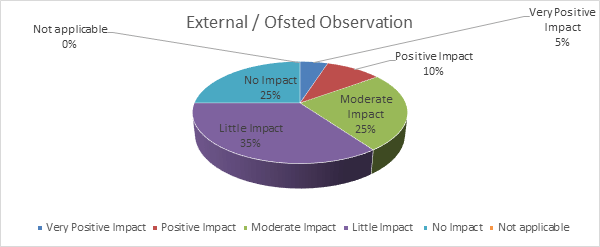
Question 5: ‘How do you judge the impact of observation from an external observer/Ofsted inspector?’
Questionnaire and interview responses revealed surprisingly strong level of disapproval for observation by an external observer or from an Ofsted inspector. Such sentiments also appear recent work from O’Leary and Wood (2017),whose research observes apathy and distrust from beginning teachers to the process and value of external inspection. Without contextual knowledge about the teacher or the class, they argue that observers are prone to making spurious and ill-informed judgements, and this was certainly echoed by some of the responses in interviews:
Reflections
These excerpts from my research go some way to illustrating what I perceive to be a shift in observational culture since the practice of grading individual lessons [by both Ofsted and during school’s internal processes] ceased between 2013 and 2015. Increasingly, when speaking to current PGCE trainees and past trainees, I am surprised by the lack of resistance to formal observation and have noted, if anything, a thirst for more observation.
What seems clear is the importance of subject specificity in lesson observation in feedback, and the limitations of observation through the lens of ‘generic competences’.
We need to talk about History
References
O’Leary, M., (2013) Classroom observation: A guide to the effective observation of teaching and learning. Abingdon: Routledge.
O’Leary,M., (2013) Surveillance, performativity and normalised practice: the use and impact of graded lesson observations in Further Education colleges, Journal of Further and Higher Education London: Routledge Vol. 37, No. 5, 694–714.
Worth, J., Sizmur, J., Walker, M., Bradshaw, S. and Styles, B., 2017. Teacher Observation: Evaluation Report and Executive Summary. Education Endowment Foundation.
Recent searches for guest speakers on Women’s History turned up a fabulous link to John Ryland’s Library with UoM’s Widening Participation lead for libraries, Adam Cooke, and Dr Janette Martin, curator of the Library’s Peterloo exhibition: Manchester’s Fight for Freedom. As I’ve said before, at a university the size of UoM, there is always something interesting going on, and this year has provided some great opportunities to enhance the PGCE History student experience.
As a schoolteacher for 13 years I’m sometimes guilty of having a slightly parochial mindset – that is to say I’m often ignorant of the many things going on around me at UoM and sometimes don’t look beyond the immediate confines of MIE and SEED. This collaboration with John Rylands definitely has legs and resulted in some of the strongest student feedback I’ve received in the last 3 years. Janette Martin is an expert in the true sense of the word and the curator’s tour she treated us to was a fascinating insight into individual stories and lives before and after Peterloo. Interestingly, the theme of ‘fake news’ appeared during the tour, with pro-government newspapers propagating blatantly falsified information concerning some of the protesters and their families. It was also interesting to note changing attitudes to Peterloo over time; it seems that it’s only now that we are fully grasping its significance and commemorating Peterloo for what it was – a turning point in British History and a defining event in the History of Manchester. That the hundredth and hundred and fiftieth anniversaries of Peterloo should go by with barely a whisper is incredible.
Discussions with Janette about Jeremy Deller’s monument to Peterloo led to me recommending a fabulous piece of television history by the same artist. I wholeheartedly recommend Deller’s exploration of British History and the explosion of house music between 1984 and 1992. ‘Everybody in the Place: an incomplete History of Britain 1984-92’ is a wonderful piece of television, not least because it subverts the traditional narrative about the arrival of house music into the fabric of British life. It is described by the BBC as a ‘re-evaluation of acid house, a musical phenomenon that, as this film shows, did not spring out of nowhere, but owed its emergence to the social and political landscape of 1980s Britain.’ Whatever, it’s a great watch and the perfect entry point for school students and other millennials hoping to understand British society in the period.
What next? We’re planning further work with Adam at John Rylands Library and are hoping to access some of the extensive archive material stored there, amongst which are missives from Emmeline Pankhurst and Winston Churchill. We’re considering how to increase footfall from secondary schools and are aiming to plan out fieldwork opportunities later in the year. All in all this has been a great advert for collegiality and I’m thrilled the PGCE Historians are connected to such a wonderful resource.
Where can this collaboration take us next? A report will follow in March as we use the archives to plan teaching episodes for Placement 3.
Janette and I penned a joint entry for the John Ryland’s Special Collections blog which can be found at:
Last month illustrated perfectly how the size and scale of UoM can lead to great opportunities to access expertise that enriches the PGCE History experience for students. It’s easy to forget that on a campus over a mile long and half a mile wide that there are interesting things going on at all times of the year.
On Thursday the PGCE Historians saw the University’s renowned Professor of Public History, David Olusoga, deliver two equally fascinating keynote speeches to two different audiences at UoM. Olusoga’s recent contribution to the landmark television series ‘Civilisations’ was one of the highlights of television History in 2018. In the morning were able to join an audience comprised mainly of school pupils from across Greater Manchester and listened as Olusoga spoke eloquently about the need for better representation of Black History in both school curricula and the wider media. Reflecting on Christopher Nolan’s recent epic ‘Dunkirk’, Olusoga reminded the audience how the film’s meticulous attention to detail stopped short of the inclusion of the many black troops who were present – just one example of the film industry getting in wrong when dealing with historical events. Olusoga drew on a number of anecdotes to illustrate how all too frequently, black history is overlooked in the ‘grand narrative’. For me, the great importance in attending the event was that the 15 beginning teachers in attendance would now go on to consider Olusoga’s words when devising their own curricula in the coming years and make their own schemes of work more inclusive.
The afternoon’s session, part of UoM’s ‘Brilliant and Black’ series of events, was equally fascinating, as trainees travelled half a mile further down the road to hear David Olusoga address a predominantly adult audience and deliver an entirely different address. The focus here was the legacy of Enoch Powell and the links between his rhetoric and many contemporary views on what it means to be ‘English’. There were powerful reminders of the gross injustices of the Windrush scandal and one of the best examples of a question and answer session I have seen in recent years, with Olusoga fielding a variety of questions ranging from views on the causes of Brexit to his own Black hero. Utterly riveting and without cost.
Importantly, there was a heated discussion about the day’s lectures back at University to finish off – and there is very much the sense that we have unfinished business in ensuring that our curricula are inclusive and representative of the populace as a whole.
A key question generated from end of day discussions: do we need to move away from packaging the History of different groups into specific months, or should we be aiming for an inclusive reading of History that represents voices from all groups?
This is an example post, originally published as part of Blogging University. Enroll in one of our ten programs, and start your blog right.
You’re going to publish a post today. Don’t worry about how your blog looks. Don’t worry if you haven’t given it a name yet, or you’re feeling overwhelmed. Just click the “New Post” button, and tell us why you’re here.
Why do this?
Because it gives new readers context. What are you about? Why should they read your blog?
Because it will help you focus you own ideas about your blog and what you’d like to do with it.
The post can be short or long, a personal intro to your life or a bloggy mission statement, a manifesto for the future or a simple outline of your the types of things you hope to publish.
To help you get started, here are a few questions:
Why are you blogging publicly, rather than keeping a personal journal?
What topics do you think you’ll write about?
Who would you love to connect with via your blog?
If you blog successfully throughout the next year, what would you hope to have accomplished?
You’re not locked into any of this; one of the wonderful things about blogs is how they constantly evolve as we learn, grow, and interact with one another — but it’s good to know where and why you started, and articulating your goals may just give you a few other post ideas.
Can’t think how to get started? Just write the first thing that pops into your head. Anne Lamott, author of a book on writing we love, says that you need to give yourself permission to write a “crappy first draft”. Anne makes a great point — just start writing, and worry about editing it later.
When you’re ready to publish, give your post three to five tags that describe your blog’s focus — writing, photography, fiction, parenting, food, cars, movies, sports, whatever. These tags will help others who care about your topics find you in the Reader. Make sure one of the tags is “zerotohero,” so other new bloggers can find you, too.


![Text Box: TD – Have there been any occasions where lesson observation has not been helpful? Why was this so?
Interviewee – Ha! [laughs] Well we had Ofsted in my first term and I got observed then for like, maybe 15 minutes. The inspector came in my room and sat down and frowned and looked in a few books. [Pauses, shrugs and looks exasperated] And then he got up and left. And that was it. I never even got any feedback. I mean what is the use of that?](https://tomdonnailecturerinhistoryeducation.school.blog/wp-content/uploads/2020/01/pie6.png?w=602)
 University of Manchester History PGCE