Thinkpiece 3: How do History NQTs view lesson observation?
As a former Assistant Head and Professional Mentor, and more recently a course leader on a University based PGCE programme, observing lessons has been integral to helping me form judgements about the progress of ITE participants over the past 10 years. Lesson observation, as O’Leary (2013) observes, is a ‘ubiquitous mechanism’ and is the principal means of assessment of trainee teachers. I’ve always been interested in its efficacy, particularly where teacher development is concerned. It’s difficult to imagine a system of assessment for ITE participants that does not include a significant number of formal and informal observations for trainees, but there seem to be lacuna in the body of knowledge surrounding how trainees view observation and from whom they gain value in the process.
It is only really since the emergence of New Labour in the 1990s that lesson observation in schools has become ‘universal’ in secondary schools, yet in the intervening 23 years, little research has been undertaken about trainee perceptions of its impact, particularly in the field of History education. Recent research from the EEF teacher observation project (2017) found no evidence that teacher observation improves combined GCSE English and maths scores, yet little or no work exists that explores the impact of lesson observation, and the attendant perceptions of beginning History teachers about the value and impact of lesson observation in its many forms.
Experience of working as a lesson observer in both school and university contexts encouraged me to explore lesson observation in more depth, and the following graphics and discussion, taken from work on my MA dissertation, explore the views of a cluster of 25 History NQTs who were based in North West schools in the 2017/18 academic year. As a History PGCE course leader I feel strongly that finding out more about the subject is critical; revisions to the Ofsted framework school inspection and for the inspection of ITE mean that capturing the views of beginning teachers are more important than ever. Are current approaches to lesson observation perceived to be effective? Which types of observation are viewed as the most impactful and valid? Whilst this small scale study provided no conclusive answers, the following graphics provide some interesting food for thought and will form the basis on ongoing research.
Question 1: For formal observation, does your school use..’
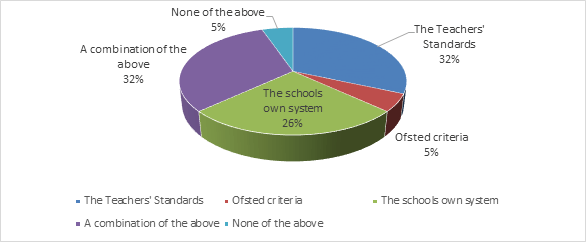
It was interesting to note the range of approaches employed by schools to lesson observation and the findings from this question formed the basis for further questions about the perceived value of each. Incidentally, the grading of individual lessons appears to be historic practice and is all but obsolete; none of the 25 respondents reported lesson grading in their schools.
Question 2: ‘Formal lesson observation has helped to improve my teaching skills’
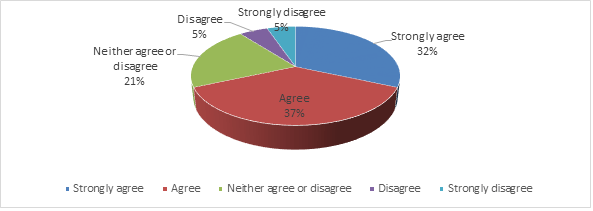
The move away from grading lessons may explain to some extent why perceptions of formal observations were positive in general; perhaps the move away from ‘performative’ style observations and an increasing focus on ‘developmental’ feedback helps to explain such perceptions. Responses to the follow-up questions in semi-structured interviews revealed generally positive perceptions around the extent to which formal observation improves teaching skills and helps NQTs to make progress against the Teachers’ Standards. It was interesting to see the theme of collegiality recur in these interviews and this might go some way to explaining why perceptions of interviewees was generally very positive where formal observation is concerned.
Question 3: How do you judge the impact of observation by your Subject Mentor?
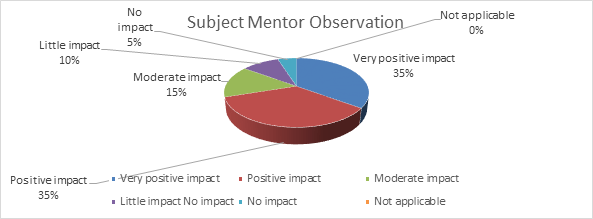
I was fascinated by the response to this, and the following question. The depth of approval for a subject specialist observer was clear.
Question 4: How do you judge the impact of observation from a History specialist?
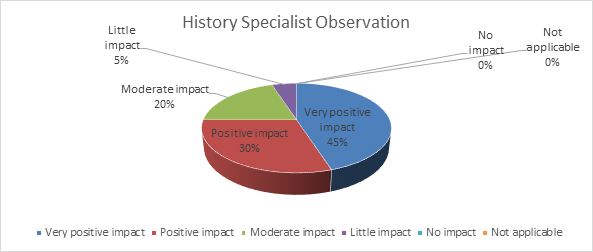
In fact, observation by a subject specialist (Figures 9 and 10) received the highest level of approval of all the different observation types explored. Clearly, subject specialist observations for beginning History teachers offer a unique opportunity for pedagogical development, and the support for this type of observation seems to be echoed by the strong level of approval from questionnaire participants and interviewees. My hunch is that trust and respect are important preconditions in the observation of trainee teachers; responses here seem to support this view.
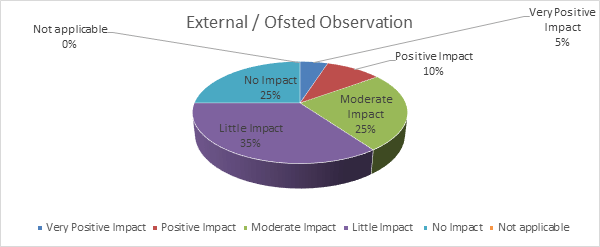
Question 5: ‘How do you judge the impact of observation from an external observer/Ofsted inspector?’
![Text Box: TD – Have there been any occasions where lesson observation has not been helpful? Why was this so?
Interviewee – Ha! [laughs] Well we had Ofsted in my first term and I got observed then for like, maybe 15 minutes. The inspector came in my room and sat down and frowned and looked in a few books. [Pauses, shrugs and looks exasperated] And then he got up and left. And that was it. I never even got any feedback. I mean what is the use of that?](https://tomdonnailecturerinhistoryeducation.school.blog/wp-content/uploads/2020/01/pie6.png?w=602)
Questionnaire and interview responses revealed surprisingly strong level of disapproval for observation by an external observer or from an Ofsted inspector. Such sentiments also appear recent work from O’Leary and Wood (2017),whose research observes apathy and distrust from beginning teachers to the process and value of external inspection. Without contextual knowledge about the teacher or the class, they argue that observers are prone to making spurious and ill-informed judgements, and this was certainly echoed by some of the responses in interviews:
Reflections
These excerpts from my research go some way to illustrating what I perceive to be a shift in observational culture since the practice of grading individual lessons [by both Ofsted and during school’s internal processes] ceased between 2013 and 2015. Increasingly, when speaking to current PGCE trainees and past trainees, I am surprised by the lack of resistance to formal observation and have noted, if anything, a thirst for more observation.
What seems clear is the importance of subject specificity in lesson observation in feedback, and the limitations of observation through the lens of ‘generic competences’.
We need to talk about History
References
O’Leary, M., (2013) Classroom observation: A guide to the effective observation of teaching and learning. Abingdon: Routledge.
O’Leary,M., (2013) Surveillance, performativity and normalised practice: the use and impact of graded lesson observations in Further Education colleges, Journal of Further and Higher Education London: Routledge Vol. 37, No. 5, 694–714.
Worth, J., Sizmur, J., Walker, M., Bradshaw, S. and Styles, B., 2017. Teacher Observation: Evaluation Report and Executive Summary. Education Endowment Foundation.
 University of Manchester History PGCE
Great blog Tom, interesting read.
LikeLike
Testing
LikeLike
Interesting post, and I agree there is definitely a thirst for more observations from most people. The 5% or there abouts who say it has little impact are interesting and I wonder if this could be investigated in more detail – is this due to communication breakdown and/or clash of personalities? I often think that in any kind of feedback in any walk of life or job there almost needs to be a conversation (sometimes even training) of how to enagage with it in a professional manner, and how to learn from it. I mean why wouldn’t you listen to people with far more experience (unfortunately some people don’t!).
It is surprising that “little research has been undertaken about trainee perceptions of its impact, particularly in the field of History education” (there sounds like there is PhD in there somewhere for someone!)
Thanks.
LikeLike
An interesting read Tom, and I totally agree with what you say about the relationship between observer and observee, as if there is no relationship or a poor one then the observation can feel a lot more pressurised and unnatural. On the other hand I feel like observations from colleagues and mentors that I was closer with, although sometimes the most critical, provided feedback that resonated with me the most because of who said it.
LikeLike
A thought provoking read and I am in total agreement that a relationship between the observer and the teacher being observed is incredibly important to put the teacher being observed at ease and take the intense pressure away. This is why observations that I have experienced as a trainee so far during the course have been nice because I have felt comfortable with the person observing me. Also, I was happy to receive more critical feedback from the mentors as I have developed a relationship with them.
LikeLike
This is very interesting Tom. As your findings suggest, observation generally has a positive impact on outcomes and is beneficial in terms of pushing up overall standards. I have found my observations incredibly useful and have been guided on how to use feedback to improve.
Perhaps for the wider profession more work needs to be done in terms of teaching trainees to make the most of their observations.
I think observations can be highly beneficial both ways. Encouraging trainees to observe other lessons is a way of modelling good practice which can help them reflect on their own teaching.
LikeLike
Really interesting to see this, I think the impact is always positive if you can leave with tangible advice on how to improve and secure your strengths whilst addressing your weaker areas.
LikeLike
This was an extremely interesting read, Tom. I myself find feedback from observations absolutely essential to my development as History teacher. It informs both what I am doing well at and what could use work. The difficulty however, is that observation will (in my mind) always be subjective, and feedback dependent on the observer. There an infinite amount of ways for a History lesson to be taught, and observers all have their choice of poison. Therefore on occasion, I have felt that I was doing things within lessons in order to tick a box with certain observers (i.e approaches to behavior management, certain task design etc.) I don’t know how this could be remedied beyond the set of ‘success criteria’ which is already in place.
In terms of how people felt about a ‘history specialist’ observing, I would totally agree. There is both an expertise for the pedagogical approach of the lesson and the content itself. With History in particular, I feel a teacher’s confidence to employ accurate and extensive subject knowledge is important to gaining credibility with the students. Therefore, I do feel I benefit from specialist feedback, as this can direct me on how to teach a particular historical topic or skill, opposed to just the basics of classroom presence.
Aligning with some of the above comments, I would also agree that I feel happy receiving feedback and critique from a mentor that I have developed a good relationship with. It is easier to take critique off someone who understands the context and your capability, and their critique can provide you a bespoke blueprint on how to progress.
LikeLike