Delivering PGCE courses ‘remotely’ over the past three months has certainly presented challenges at times, but many of these have created opportunities in turn. There has been a steep learning curve for providers and trainees alike, but increasing use of platforms such as Zoom and Blackboard collaborate have yielded some great results in recent weeks.
Working within the partnership during the pandemic
Providing PGCE trainees with a balanced and broad diet of training inevitably relies to some extent on quality inputs from practitioners in our partner schools, especially when visiting speakers have an area of specialism in their own subject. Enter Ben Scott, Professional Mentor and Teacher of History & Politics at Wellington School in Timperley. Ben and I started our collaboration back in January, after I approached him to deliver a day of teaching at UoM focusing on A-Level History and Politics. His brilliant session back in January was to be followed by a session at UoM in early June in which trainees would showcase their A level skills and present bespoke lessons on a variety of A- level History topics, ranging from the Russian Revolution to Second Wave feminism in 1970s. America.
The closure of University buildings in March meant that the session needed to be redesigned and delivered on Zoom. Despite our initial misgivings, the day turned out to be a triumph of sorts, as trainees delivered and critiqued their A- level lessons to Ben, myself and other trainees, with Ben providing specialist feedback.
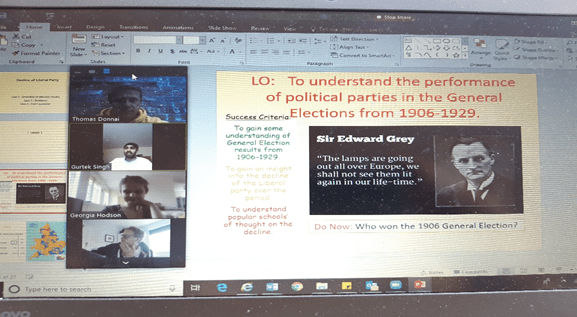
Ben Scott summarises the collaboration and its outcomes below: As Professional Mentor at Wellington I’ve sorely missed the interaction with trainees during lockdown and from start to finish these presentations provided a great opportunity to re-focus my critical eye. I was hugely impressed with the quality throughout with the small group Zoom sessions running much slicker than initially expected. It was clear that a great deal of thought had been put into each presentation as all trainees without exception were able to outline a clear rationale in terms of both pedagogy and content. Screen-sharing meant they were able to explain their rationale with confidence, making giving specific feedback straightforward. Exam specifications had been researched in detail, there were clear references to exam technique, scaffolding activities, differentiation, academic rigour and placing the lessons within the ‘big picture’ of the 2 year course. It was also really pleasing to see lots of reference to metacognitive strategies, something which we’ve been working hard on at embedding in our practise at Wellington. Undoubtedly, the sessions were a real success, it was great to see the progress the trainees had made since my session back in January and it was evident that the trainees had developed into confident A Level practitioners.

Joe Kilner and Kate McCoubrey talk us through their lesson on Second Wave feminism in the 1970s
What next?
Whilst it is safe to say that most trainees, tutors and mentors prefer ‘face to face’ teaching to other alternatives, the collaboration made it clear that the use of online platforms such as Zoom can work brilliantly too. Importantly, trainee feedback made it clear that ‘small group’ presentations work just as well remotely, with some notable advantages. Kate and Joe cited a ‘complete lack of nerves’ and ‘relaxed atmosphere’ as benefits of the activity, whilst Gurtek stressed that ‘quality feedback from and expert in A-level History [Ben, not me!] was an advantage, going on to say that ‘I actually prefer doing this type of presentational activity online’.
Ben and I will be delivering a presentation on our collaboration this year at the forthcoming Partnership Showcase on July 3rd, and are already planning follow up work with the 2020/21 cohort.
Ongoing uncertainties around when face teaching will begin mean that Zoom, and similar platforms may yet play a significant part in the delivery of our PGCE programmes. In working creatively and collaboratively with our partners, we at UoM can ensure that our ITE provision continues to be outstanding.
 University of Manchester History PGCE
Zoom certainly has its merits in a COVID 19 context and has helped me remain focused on the course- hopefully face to face contact will be back soon as nothing can substitute being in a room with your course mates and tutor
LikeLike
Zoom has been very useful to bring us all together regardless of where we are. I think we could all do with a ‘how to use zoom’ training session in the future?
LikeLike
Great article here about the challenges and rewards of online teaching! I personally feel I have benefitted from online teaching since it was done to such a high standard. Furthermore, I agree with the comments being made about the relaxed atmosphere. Thinking to the future, having to become accustomed to platforms such as Zoom and Microsoft Teams has helped me adapt my pedagogy further and this is something we have discussed as a cohort. Great work!
LikeLike
Really informative stuff
LikeLike
it was a really positive experience for my views on virtual learning, which I’ve always thought too clunky and time-consuming to get the same sort of engagement and discussion generated as an actual classroom. I think doing it in small groups made it much more comfortable for participants to speak and listen without being interrupted or feeling like they’re being put on the spot. Very relevant for all the other teachers dreading virtual lessons with year 10 this September!
LikeLike
it was a really positive experience for my views on virtual learning, which I’ve always thought too clunky and time-consuming to get the same sort of engagement and discussion generated as an actual classroom. I think doing it in small groups made it much more comfortable for participants to speak and listen without being interrupted or feeling like they’re being put on the spot. Very relevant for all the other teachers dreading virtual lessons with year 10 this September!
LikeLike
Although nothing can beat face to face interaction and teaching i have found our ability to adapt really amazing and hopeful for the future. There are always going to be some technical difficulties but it can be done and i’m sure with practice and lots of trial and error, virtual learning could become a valuable supplement to face to face teaching. the mechanics are simple even for those who are not tech minded! like myself!
LikeLike
Really enjoyable read Tom. I feel that despite the current climate, we have been able to achieve a significant amount through the medium of online learning during this time. As you assert within this piece, this was particularly visible in the A level sessions with Ben. I think this can be attributed to, as you mention, the small groups within these calls. This is something I hope to take away and implement into my own lessons in September. This period of virtual learning (soon to be hybrid most likely) has been tricky to navigate, yet I feel that this experience has been extremely positive. It is a welcomed challenge!
LikeLike
Great article demonstrating that quality training can still be delivered despite lockdown restrictions. The session ran very smoothly and the atmosphere was positive, with helpful feedback from both Tom and Ben. Although I prefer face-to-face activities and teaching, this setup certainly makes the very best out of a difficult situation!
LikeLike
Excellent article! Online teaching may not be ideal but the commitment to providing quality lessons in the circumstances has been enlightening. It will be interesting to see how these platforms will be incorporated into teaching environments in a post lockdown society and how it will influence the way we teach going forward.
LikeLike