Peter Brade, PGCE Historian at UoM, reports on the recent work with Dr Jeff Evans on LGBT+ History and inclusive curriculum building

“An inclusive reading of the past must greatly assist the creation of a more reliable interpretations of our past and thereby history” was the goal essayed by Dr Jeff Evans (Research Fellow Liverpool JM Uni. & Director of the annual OUTing the Past International Festival of LGBT+ History in what was a fantastically illuminating session. However, he went on to suggest that secondary school history still has some way to go in offering secondary school pupils such an inclusive and thereby relevant History curriculum. At best LGBT+ History, like other ‘minority’ (e.g. Women’s & BAME History) readings of the majority’s past experiences and events are left to progressive departments and individual colleagues to try and integrate into their curricula. To do so is can be and is an uphill struggle and consequently diverse and often highly relevant History is absent from the classroom as it in the National Curriculum. Such systemic failure to integrate the rich and diverse reading of the majority’s past is not only presents a serous educational deficit. Such licensing of ignorance can only feed the fear of difference that fuels such disharmony and even violence and hate crime within our richly diverse and multicultural society. For example, that 45% of LGBT+ students experience bullying in the secondary environment and racist hate crime figures are again alarmingly on the increase. Indeed, school’s history is an ideal vehicle for not only validating diversity but also highlining our humanity beyond our differences. [Cannadine, D.2013]
In order spur the next generation of History teachers to push for change, Tom Donnai (History PGCE lead) invite Dr Evans to deliver a bespoke session to our cohort on enriching the curriculum and making it more diverse and thereby directly relevant to 21st century students. Employing a distinctly humanist model, Dr Evans began the session by asking, what was the function of History Teaching? That is both as an academic subject and as a subject in the school curriculum. Dr Evans highlighted how the traditional function of state school History was to promote and legitimise British nationalism and Empire, strengthen an ‘us vs them’ narrative and socially acceptable role models. In agreement with Dr Evans, the PGCE historians believed that contemporary school History should encourage healthy scepticism, disrupt the ‘concrete’ base of society and show what happened in the past is immensely relevant to our lives today.
With the theme of disruption in mind, Dr Evans showcased a current classroom chronology sort activity based on LGBT+ past events and individuals. Encompassing Ancient Greece up until the 21st century, this activity highlighted the non-linear paths that attitudes to LGBT+ people have taken and also added some much-needed rainbow colouring to the rich tapestry of History. The main point of this activity, however, was to demonstrate to the cohort the lack of integration of LGBT+ History intro the curriculum as well as demonstrate potential methods to employ in the classroom. One of the most prominent examples employed was that of King Edward II and the potentially ‘homosexual’ (sic) relationship he had with his companion, Piers Gaveston. It was agreed that, with the English attempts to conquer Scotland in the 13th and 14th century being on the National Curriculum, a lesson into Edward II’s sexuality would be fairly easy to integrate and, alongside disrupting popular views on medieval life, would expose students to differing historical interpretations and primary sources.
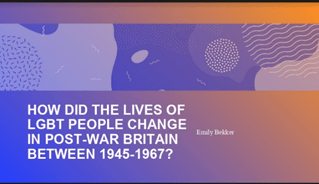
Turning to the afternoon session, Dr Evans set the cohort the task of creating their own LGBT+ lessons. Giving the PGCE students free reign to pick their period, lessons were created on Section 28, the development of Canal Street in Manchester and the treatment of LGBT+ Second World War personnel. Such lessons not only demonstrated the creativity of the trainees, but highlighted how complicated, messy and positively disrupting LGBT+ History can be. Emily Bekker’s lesson, for example, showed how during the Second World War the military authorities cared little for the sexuality of those within, but as soon as the war ended the spectre of institutionalised homophobia returned. Lessons such as Emily’s only serve to show pupils how flexible societies so-called norms are as well as shed light on an area completely ignored by the National Curriculum
On a personal note, Dr Evans’ session taught me more about LGBT+ History in a single day than almost 20 years of state education had. Dr Evans’ session highlighted how LGBT+ History can not only illuminate previously hidden histories, but also break down existing barriers. It is up to History teachers to be the vanguard of such change, however, and show how LGBT+ History can be successfully integrated to create a truly inclusive National Curriculum.

