PGCE History 2020/21:End of Year reflections

By PGCE History Subject Leader Tom Donnai and some of the 2020/21 PGCE History trainees

I asked some of this year’s trainees to write me a paragraph answering two questions: What have you learned this year and what will you take into the classroom next year as ECTs [Early Career Teachers]. Here’s what they came up with…..

‘The cohort of 2020-2021 will always be remembered for being the second batch of Covid-19 affected trainees. It is not exactly a desirable badge of honour but we will all wear it with pride knowing that the extreme challenges this year has posed have helped us to become more resilient, patient and collaborative teachers. I am so grateful to have completed my PGCE with the University of Manchester and believe the most important aspect of education, inclusivity, has been at the centre of everything we have done both through the university side and teaching side of things. Going into my ECT year (yes a new acronym!!!) I am planning to develop strategies further for a rich and engaging curriculum that luckily my employment school is already rolling out in an incredible way.’ Julia Morton

‘During this year I have learned that a career in teaching will be more fulfilling than you could ever imagine. I have also learned that teachers are simultaneously the most organised and least organised people I have ever met. Going forwards into my career in teaching I am going to maintain my passion for inclusive and diverse history. Further to this I am going to try to maintain the level of resilience that this COVID ladened year has required of all teachers. In the future I’m sure we will all be able to look back on this time and feel as though this has shaped us all as people and teachers.’ Ethan Dent

“The past year has been fantastic for me. Tom, Paul, my mentors, schools, and the University have all given the best experience possible. At the start of the course, I was quite nervous and unsure if I was going to be able to make it in the classroom. Since then, I feel I have gone from strength to strength, not only in the classroom, but on a personal level too. Whilst it is true that there is nothing like teaching, there is also nothing like the History PGCE course at the University of Manchester. Simply the best in the business. ” Peter Brade

‘The PGCE program that I completed with Manchester University was undertaken during a time of huge uncertainty and disruption, particularly within the education sector. However, thanks to the efforts of Tom, Paul and others within the PGCE team, many aspects of the course were able to continue seamlessly. I have been able, not just to survive a teacher training course during COVID times, but also thrive in an evolving educational environment that is ever more reliant on technology and remote learning strategies. I will certainly go into my ECT year armed with a rich array of subject-specific teaching strategies, which will help me stand out amongst others, and has helped me become a modern and inclusive secondary school teacher’ Taylor Pearson

 ‘My year as a PGCE History Trainee has taught me that I am more resilient than I ever thought I was and that is down to the high-level of support I have received from my UoM Tutor whilst progressing throughout my training. This course has had a huge impact on my development as a teacher with top-level, engaging CPD enhancing my understanding of different approaches and teaching and learning techniques I can use to take into the classroom. I have learnt so much throughout this course ranging from enhancement in subject knowledge to enhancing my understanding of diversity and differentiation within education. One thing I will take into my ECT year as a new teacher is to continue to develop my own teaching skills to ensure that my students can receive the best learning outcomes possible and to remain confident and positive throughout my progression in this profession.’ Hannah Ruddock

‘This year has been an absolute whirlwind and it’s very surreal to be a qualified teacher in the coming weeks. I’ve learnt so much in what is actually a very short time. The main things I’ve learnt are how resilient and adaptable I am and I think that’s really key to teaching, realising your own strengths. Without these skills I wouldn’t have been able to cope with online learning, having one of my placements in a challenging school and even going through the interview process over and over. These skills didn’t emerge by themselves, the course and the people in it helped me find and work on them. The PGCE gave me numerous tools that I could build on and my mentors kept my progress in perspective when I was feeling like a failure. This year has given me a great foundation to build on as I hope to keep proving myself, not to others, but to me. It’s easy to focus on the negatives or the areas for improvement but it’s just as important to reflect on the progress and the positives and that’s what I’m going to take into next year. So next year when I begin to take on more and really challenge myself, I know I’ve got the tools and the resources needed to get through it because of what the course has provided me’. Emily Bekker

Becoming a teacher requires constant reflection, and at the end of the road, I thought I’d share some of mine. I learnt the value of individuality, as a teacher and amongst my pupils. I learnt that the curriculum could be better, and we have the power to change it. I can differentiate, plan, resource, evaluate, mark, assess and more! I have also learnt to never rely on technology, wear sensible shoes and invest in decent whiteboard pens. The teachers coming out of the University of Manchester PGCE Secondary History Class of 2021 are some of the most talented, humble, passionate, and resilient people I could have hoped to meet, and I’m proud to stand amongst them. This year has been turbulent to say the least- at times, the pirate ship of jolly Historians was sailing strong, and at others, we were in a maelstrom of deadlines, COVID protocols, and placement demands. Every good ship and crew needs a Captain, and we couldn’t have hoped for a better one than in Tom. Thanks for being a tutor, a friend, and a shoulder to lean on when I’ve needed one- I couldn’t have done this year without you’. Marie Bennett

My year on the University of Manchester’s PGCE Secondary History course has truly been a whirlwind – from meeting everyone and thinking that surely COVID measures wouldn’t be in for much longer, to catching COVID myself, to having to teach online for almost a whole term, to finally finishing the course still in the midst of COVID restrictions. Nevertheless, I still don’t think I would change the experience because it’s led to us becoming an incredibly tight-knit group, as well as being a genuinely formative experience in my life. Tom, our university tutor, has been the perfect captain for steering the ship of PGCE history, and I have had brilliant experiences with my two mentors – Helen, at Bury Church of England High School, and Phil, at Falinge Park High School. I feel that I am an infinitely more confident and effective teacher than I was at the start, and I am already looking forward to my next challenge – my ECT year at Wright Robinson College. I will take on board many of the lessons that I have learnt this year, but perhaps most important of all, I will seek to infuse my lessons with the zesty discussion that I have been a part of this year and evolve any stagnant historical enquiries into rigorous, progressive schemes of work.’ James Clarke

‘I came into this PGCE thinking that I already knew a lot about teaching, as I’d had 2 years as an assistant language teacher in Japan. Boy was I wrong! While it was a slightly tumultuous year due to world events, the one constant I had was my steep learning curve as a trainee teacher, and the support from my university mentor. I’ve learned so much in this year: dozens of little planning-related details and tricks that make the world of difference in the classroom, and make your life a lot easier; how to teach effectively online; it’s a good thing to go off-book in your lesson; and mostly importantly that I can teach. I think we’ve all had that one moment in our training where we realised ‘oh right, I can actually do this!’ and it’s such a great feeling. I’ll miss touching base in uni days, but I know I’ve got a network of great fellow trainee teachers available for support just a Whatsapp message away. The main thing I’ll take into the classroom as a History teacher next year is a focus on always questioning the curriculum – how can it be more diverse? More relevant to the lived experience of my students? More forward thinking? These are the most important questions to ask and I’m lucky enough to have landed in a department where those questions are encouraged and rewarded.’ Emma Hollis

I waited to do a PGCE History course for too many decades. I recall going in that first day, Costa and meeting students and Tom after the strangest 7 months of isolation, trepidations and fears of loved ones getting ill , an ancient preoccupation.  Hoping that this was the slow return to a different normality- ha !Tom’s zeal and welcome was instant and genuine. He had collected a varied cohort and within a couple of days,  we were a team . I felt out of my depth in so many areas- American cold war history, American Civil Law, LGBTQ+ history, African History, History of the East, Mussolini, google drive 🙂… an endless list. The energy and positivity in the group was the best resource to draw on in 2020.I enjoyed the way pedagogy was woven into historical discussions and controversies, unpicking aspects of the curriculum and prompting new directions, drawing on expertise of historians and teachers. Great to be having to think hard. 

Ruth Davenport
Reflections on Sixth Form Experience: Trainee, Mentor and Tutor perspectives

By Megan Kemp (UoM PGCE History trainee), Tom Donnai (PGCE History Tutor) and Ben Scott (Professional Mentor, Wellington School)

Megan Kemp, PGCE History trainee

Although our experiences at both of our placement schools had been massively rewarding, there was one area where our skills were yet to be developed: the challenge of teaching A-Level History in a sixth form setting. As our placement schools catered only for students aged 11-16, our Tutor Tom set up a two-day excursion to the excellent Wellington School, Timperley. We’d covered A-level History previously at University and were now keen to put our learning into practice by planning and teaching revision sessions to Wellington’s wonderful year 13 students.

We got a good feeling as soon as we walked into school: from the VC memorial in the reception to the satirical Trump memorabilia in teachers’ classrooms, you were immediately greeted with the sense that this is a school that takes its history seriously, but with the personable twist that is so key to engaging students in the subject. Fellow PGCE Historian Emma Hollis (in Timperley by way of Canberra, Australia) is joining a great department as an ECT next year!

Our two days were spent teaching and observing Y12 students in History and Politics lessons under the stewardship of the gregarious Mr. Scott, and his dedicated and enthusiastic department. We saw politics pupils taking responsibility for their learning with independent presentations and responding to challenging questions on constitutional reform with aplomb. In history it was a real joy to see the depth of understanding and analysis of a variety of epochs that the students were able to engage with. What’s interesting with A –level history is that while the ‘nuts and bolts’ of the subject are no different to KS3 and GCSE history, the atmosphere and classroom culture seem subtly different, with a really nice, discursive feeling that reminded me of my undergraduate seminars somewhat.

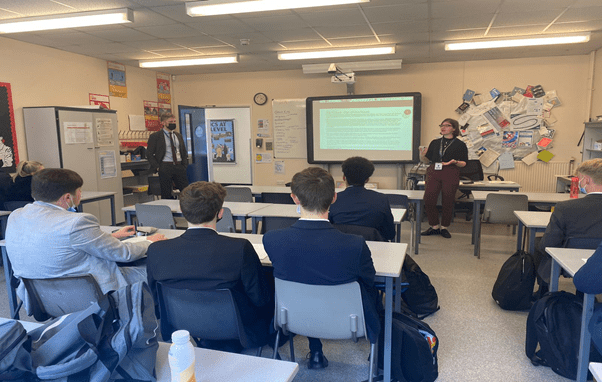
Megan and Ethan deliver the first of their revision sessions to Year 12 Wellington History students

During our time at Wellington, we were tasked with teaching pupils on the dying days of the Wars of the Roses and the rise of Henry VII – a real challenge for us modern European historians and definitely not my ‘specialist subject’ on Mastermind! After a frantic night reading up on the subtle nuances of 15th century politics, we delivered our session to pupils who were both respectful and intelligent, and asked probing questions that kept us on our toes.

After our teaching sessions, we were invited to witness a debate club centred on prison reform; this was a controversial topic that was explored with both maturity and loquacious zeal. As Tom would say, it was a great example of ‘zesty discourse’ and that is most certainly a good thing in the classroom. It allowed us to see the more personal, informal side to the students at an age that we were previously unfamiliar with in the classroom. The students had clearly done their research and approached the debate with an enthusiasm that reflects the ethos of the school at large. There are definitely some budding politicians and historians amongst them!

Even during such a short time we were both able to get a taste of the student-teacher dynamics for sixth form teaching, and I’m definitely keen to teach A-level as my career progresses. One thing we all agreed on was the critical role that secure subject knowledge plays when teaching post 16. Massive thanks to all involved at Wellington.

Tom Donnai, PGCE History Tutor

It’s often said that the step up between GCSE and A-level History is considerable, but in all honesty it’s very rare that our PGCE Historians don’t enjoy the experience of teaching A-level. There are, however, significant training issues that need to be addressed before trainees set foot in the Sixth form setting. One area we always like to address early is an awareness of the exam specification and question types; both have a big bearing on pedagogical approaches and the planning process. This is often best addressed by getting University inputs from experienced teachers of A-level who know both the specification and its demands intimately, and over the past two years we’ve been lucky to have Ben Scott of Wellington School deliver the A-level training for our PGCE Historians.

An in depth look at examples of pupil work always works well, and the opportunity to ‘ghost mark’ some student responses is a powerful way of finding out ‘what to look for’ in a strong response. To these ends, looking at ways to help students structure a response always goes down well and gives useful transferable skills for teaching at KS3 and KS4 too. The issue of building subject knowledge is less straightforward and it’s in this area that trainees sometimes feel out of their depth. It’s salutary to remember that pretty much everyone who has ever taught A-level has felt like this at some point, and this is why teaching is often referred to as a ‘life-long apprenticeship’. My advice is straightforward: read widely, watch great teachers at every opportunity, and remember to engage with the wider practitioner community on Twitter which can be an invaluable source of ideas and materials.

Ben Scott, Professional Mentor, Wellington School

This year more than ever we have been critically aware at Wellington of the need to help provide opportunities for experience and development. Thankfully, the UoM trainees were able to get a feel for almost ‘normal’ sixth form teaching [masks aside!] and it was clear they gained a lot from the experience. An intensive two day programme of observations followed by the delivery of revision lessons seemed to work well and it was great to witness the pedagogical discussions that went into the planning and preparation for Megan and Ethan’s delivery; they are both clearly talented individuals. Ad hoc discussions with those students who were taught by Megan and Ethan demonstrated that they left with a much better understanding of the issues which they would be tackling in their upcoming studies. The partnership between UoM and Wellington continues to go from strength to strength and we are delighted to have recruited a PGCE Historian from UoM to help drive the department forward with a fresh perspectives and insights!

Celebrating LGBT+ History Month 2021: Triangulating Tutor, Trainee and Academic perspectives

ITE providers of History and practitioner communities alike have increasingly considered the intellectual and practical means to address legitimate demands for greater inclusion and diversity within the school History curricula. This blog entry serves to highlight tutor, trainee and expert academic perspectives about the current state of LGBT History in schools, the attendant challenges and opportunities, and to outline a promising framework for inclusive historical enquiry therein. It also provides a selection of links and resources that may be of interest to teachers and those home schooling at present.

University Tutor Perspective: Tom Donnai, Subject Leader, PGCE History, University of Manchester

Over the past two years, the PGCE History trainees at UoM course have sent a considerable amount of time considering how to integrate LGBT histories into school History curricula. Doing so in a way that goes beyond a superficial or tokenistic approach is a challenge and one thing has become clear to trainees from the past two cohorts is this: inclusive curriculum planning is contingent on locating expertise and locating the stories of marginalised or underrepresented groups. Yet many histories are simply not written, and the challenge for PGCE trainees, and teachers in general, is to locate these stories and plan historical enquiries accordingly.

The framework by which many schools currently seek to teach of the past experiences of the marginalised majority (e.g., women, black, LGBT+, Working-Class, etc.) varies significantly and often serves as ‘bolt-on’ to the often ‘traditional’ approach to school History, which has been dominated by a male, Eurocentric ‘dominant narrative’ since the inception of the National Curriculum in 1988. This diet History education is largely removed from learner’s everyday reality and backgrounds, adding further abstraction and distance from a subject that is already conceptually removed for many students. The following quote, from L.P Hartley, seems apt with this in mind: ‘The past is a foreign country – they do things differently there’.

As a PGCE subject leader with little experience of teaching LGBT History during my own 13 years in the classroom, I was faced with a conundrum of sorts when writing a curriculum for the University of Manchester PGCE History course. Read up on the subject and anoint myself as an expert? Locate pockets of best practice in schools? The former didn’t sit well with me and the later was hard to locate. In the end, a Google search and a conversation on the mobile (whilst walking down Deansgate) with Sue Sanders, activist and architect of the first LGBT History month, was all that was needed. Sue helped me to locate the expertise that PGCE Historians needed through Dr Jeff Evans, an expert in the field, who has been working with us over the last two years to develop a framework for locating and undertaking historical enquiries for such ‘hidden’ groups in the school curriculum. Jeff has been an active campaigner for LGBT+ and human rights for the past 40 years and founded ‘Outing the Past’ in 2015, the festival of LGBT activism and History. Jeff currently works as a Research Fellow at Liverpool John Moores University.

Central to our approach is the use of local archives, which have offer unique insights into LGBT History and often serve as the perfect ‘jumping in point’ to Historical enquiries. Anyone interested in accessing our suite of free to use lessons can contact me on thomas.donnai@manchester.ac.uk and I’d be glad to share.

ITE providers of History and practitioner communities alike have increasingly considered the intellectual and practical means to address legitimate demands for greater inclusion and diversity within the school History curricula. The framework by which schools currently seek to teach of the past experiences of the marginalised majority (e.g., women, black, LGBT+, Working-Class, etc.) varies significantly and often serves as ‘bolt-on’ to the often ‘traditional’ approach to school History, which has been dominated by a male, Eurocentric ‘dominant narrative’ since the inception of the National Curriculum in 1988. This diet History education is largely removed from learner’s everyday reality and backgrounds, adding further abstraction and distance from a subject that is already conceptually removed for many. ‘The past is a foreign country – they do things differently there’.

Indeed, solid arguments can be made that the school History curricula are in fact ‘narrowing’ in their scope and focus. The content for GCSE History has been broadened significantly since the new specifications were introduced in 2017, yet there is a near complete absence of LGBT+ History within the specifications of the three main awarding bodies, AQA, Edexcel and OCR.  Moreover, with many schools now opting for a two-year Key Stage 3 and electing for a three year GCSE programme, there is pressure on departments to ‘cover’ significant tranches of the past relatively quickly and superficially, meaning that many History departments are being forced to narrow the scope of their curricula. Thus the price of a performative and ‘results driven’ culture in education is sometimes a ‘thin and watery’ curriculum.

A major obstacle faced by ITE providers in seeking to make the curriculum more inclusive, and thereby of greater relevance to learners, is the near absence of a cohesive intellectual platform on which to devise practical answers.  The University of Manchester PGCE History course has sought to address this with promising early results. 

Expert Academic perspectives: Dr Jeff Evans

The purpose of ongoing collaboration with the University of Manchester PGCE programme is relatively straightforward:

  1. To validate and promote an accessible methodology providing of unique set of teaching skills by which to implement and develop school’s history the provides an inclusive and thereby more reliable reading of our collective past. This practical teaching methodology (aka ‘Dan Chesters Method’) is embedded with a formal historiographical (philosophical, etymological & providential) reading.  An approach all the more necessary given the ambiguity of the topic (e.g. LGBT+, Queer History) a vagueness often compounded by past and contemporary identity politics.
  • This Model exploits the greater immediacy and relevance to students when learning about readily relatable events and people. The flexibility of the core model facilitates its practical usage to exploit vast areas of the past, majority history, otherwise ignored or swept to the margins. Thereby this stepped model, currently piloting LGBT+ History into the classroom provides an intellectual and practical platform for opening-up the school’s History Curriculum to a whole range of more inclusive, immediately relevant, and thereby more reliable reading of the past.

The two key questions that needed to be addressed through the production of a framework were the academic legitimacy and the methodology by which to inform the trainees in their planning of the lessons in question. Each area required specific considerations:

  1. Academic Legitimacy 

Enjoy a rigorous and professional status; to be soundly embedded within the science of History: historiography (i.e., its two branches philosophical and methodology). To this end specialist historiographical expertise is an essential ingredient providing academic credentials and general validation to trainees.

  • Methodology – The Training/Delivery Model 

Needed to be suitable (i.e. s highly practical methodology) easily accessible to history graduates/ PGCE Trainees and to lend itself to ready applicability to a wide range of professional classroom practices and scenarios.

The potential and actual gains delivery by this model result from exploiting the attendant enthusiasm (of Trainees and Students) generated by the enhanced relevance offered by the introduction of a more ‘inclusive’ previously marginalised topic, including:

  1. Deepening student’s engagement with the subject specifically and in general
    1. By creating more opportunities for local community centred learning 
    1. Offering upskilling opportunities related to collecting oral testimonies
    1. Generally developing motivational skills implicit with more engaged independent learning

Of interest to the wider school environment is that the teaching of a more relevant history also provides an invaluable contribution to students’ meaning system. The subconscious strategy by which we understand a meaningless universe (i.e., themselves and contextualise themselves with the concept of inter-personal otherness). That is greatly assisting the embedding of any and all individuals, great asset to maintaining good mental health and thereby enhancing stability.  

Trainee perspectives on LGBT+ History: Megan Kemp, PGCE Historian

When I was in school, sexuality wasn’t something to be discussed. The presumption was you were all nice normal heteronormative boys and girls – anything else was hidden under a veneer of shame and deviance. There was no room in the curriculum for LGBT history, which left me excluded as I struggled to understand my identity without the support of teachers, peers, or parents. Providing a safe space for pupils is central to the teaching doctrine, so why are classrooms not discussing more marginalised narratives – LGBT or not – for those that feel marginalised by yet another reoccurrence of ‘great white man’ history?

The structure of the PGCE History course at Manchester is invaluable – bringing marginalised narratives to the fore. Sensitive topics have been respectfully broached by experts from both inside and allied to the community. LGBT, post-colonial, disabled and other such testimonies have not been shied away from. My course mates have been fired with the zeal to smash down the door of conformity, and demand change from the ground up. I couldn’t be prouder.

However, whilst the National Curriculum is theoretically a ‘lump of clay’…you can do with it what you choose – its execution in the classroom is still lacking. The most inclusive lesson I have observed was a teacher discussing the persecution of LGBT individuals at the hands of the Nazis. That was yet another ‘well worn bullet point’ in an exhausted history Powerpoint. LGBT narratives are interwoven throughout all topics in history – we are people, and the people are what makes the past. And as Jeff is often apt to point out, ‘an inclusive reading of the past is a historically rigorous reading of the past. A cursory Google search provides numerous lesson topics for a variety of historical epochs, ripe with possibilities for including LGBT+ History: The Suffragettes? Investigate Mary Blathwayt. The Russian Revolution? Try Afansy Shaur.  The Middle Ages? An enquiry on Piers Gaveston. Integrating LGBT + Histories  into the curriculum isn’t an impossible task; it merely requires the expenditure of time and effort, just like any form of good curriculum planning.

 The National Curriculum is a relatively flexible and lightweight albatross around the neck of history teachers – it really is is what you make of it. It would be remiss of me in my duties as a teacher to expose students to the same pitfalls I experienced in school. We must do more to tell these stories, for the sake of our children’s wellbeing.

While I’m here, and for anyone that’s interested, see a short list of LGBT+ History resources that have been useful for me on my school teaching practice:

  http://www.schools-out.org.uk/

LGBT+ Representation in the School Curriculum – James Clarke, PGCE Historian

Improving representation for minority groups has been an area of focus that has dominated discussion during my year on the PGCE Secondary History course at the University of Manchester. The importance of representing LGBT+ History, specifically, has been emphasised and is therefore an aspect of the curriculum I have sought to develop while on placement.

However, the problem of under-representation is one that cannot be solved by simply ‘adding in an LGBT+ lesson’ to every scheme of learning. During discussions with the head of history at one of my placement schools, she rightly pointed out that this could be tokenistic and thus problematic in its own right. Instead, her philosophy is to focus on ‘people’ throughout history and include LGBT voices in standard historical enquiries to normalise them, rather than singling out different minority groups as ‘LGBT people’ and teaching separate ‘LGBT enquiries.’ The matter is further complicated when teaching pre-modern topics. Same-sex relationships have, of course, been ever-present through history, yet describing them as LGBT+ would be anachronistic. The oft-cited same-sex male couples in ancient Greece, for example, would not recognise the term ‘gay’ as a descriptor for their sexuality.

Nevertheless, representation should not be shied away from purely because of these challenges. To avoid tokenistic lessons, we, as history educators, should seek to intersperse LGBT+ voices within historical enquiries. Instead of having a lesson solely focussed on the 1984-1985 Miners’ Strike, it would be better practice to explore the strike through the LGSM movement’s involvement. This provides an opportunity to address the Miners’ Strike while also broaching the topic of LGBT+ experiences during the 1980s – without inadvertently segregating the LGBT+ community or focussing entirely on the ways in which they were oppressed. This method of increasing representation in the curriculum offers much richer results and is a generally fairer approach to history teaching.

Exploring practical pedagogy and innovative source work with the National Archives

PGCE Historians Marie Bennett and Ethan Dent report on a recent session with Andrew Payne from the National Archives

I think I always understood the immense value of archives for historians and record keeping, but had never much considered the use of them in the classroom. We are told as History teachers to integrate sources frequently into our lessons and we do, but often this takes the form of WW1 propaganda or PowerPoint slides with sources embedded within; I’m as guilty of this as anyone! Maybe we use an ‘original’ map or newspaper piece and think that is good enough, but in reality, we probably just ‘mined’ it from the internet with pretty poor definition and little thought about finding a better alternative. We seem to shy away from archives, deeming the original documents to be illegible or in poor condition, assuming that students might struggle with challenging primary source material.

Andrew Payne of the National Archives made us directly challenge this by providing us with a document written entirely in German. Impossible to use with KS3 Historians, right? Wrong. Through collaboration and progressively more focused analysis and hypothesising, what initially appeared as a German document created on a typewriter revealed itself to be a British intelligence record of intercepted messages from Nazi Germany, detailing the deportation of Jews into Polish concentration camps during the Holocaust. This we were able to do, knowing not a scrap of German. We relished the opportunity to engage with original source material and attempt to work out what it was and what it meant. We became detectives trying to find clues to gain meaning and context, not focusing solely on the ‘content’ as we are so prone to doing. This exercise highlighted the immense value of archives and original documents in the development of historical thinking and investigative skills, but also the joy of learning history and uncovering ‘hidden’ histories and alternate interpretations that conflict with the ‘dominant narrative’.

Andrew closed the session with a statement that really resonated with us all: “History is a verb, not a noun”. It is an active investigation of past events but remains about the present and the future. This struck a chord with me, so much so that I wrote it down on a post-it note and stuck it to my desk. History is something that we should be doing, and I intend to encourage more ‘doing’ in future lessons. Archives hold a wealth of knowledge and fascination to be explored, and we, both teachers and students alike, should be engaging with it at every opportunity. I can’t recommend working with the National Archives more strongly; there were so many great ‘takeaways’ from the session and we’ve now added to our course ‘source bank’ with a range of diverse and unique sources that will form the basis of future enquiry planning.

Exploring Windrush Stories with the British Library

UoM PGCE Historian Peter Brade reflects on recent collaboration with the British Library Schools team and considers the value of the spoken word as a powerful form of evidence

As Nelson Mandela once stated “education is the most powerful weapon we can use to change the world”; this was evident in a session conducted by the British Library that highlighted the racist attitudes faced by the Windrush generation on arrival to Britain and beyond. The British Library schools team, Reuben Massiah, Kate Fowler, Sandra Agard and Emma Bull,captivated the History PGCE cohort with a multitude of primary sources, activities and discussion points that are soon to be deployed in KS3 & KS4 classrooms.

Beginning the session with a brief introductory video, the PGCE historians were given a whistle-stop tour of the history of the West Indies as well as some background information on the Windrush generation. This was not just a fantastic resource for the PGCE cohort, but will provide KS3 & KS4 students with important historical context which is needed when tackling challenging primary source material. Following this, an interview between Oral History Curator Mary Stewart and Learning Facilitator Sandra Agard showed some good ideas on to introduce KS3 & KS4 students to oral history.  The pair highlighted how oral history can bring history alive and engage otherwise disinterested students in a manner conventional materials such as the textbook sometimes struggle to do. It’s clear that oral testimonies are unique in how they can add texture and nuance to narratives and I’m now keen to incorporate them into my teaching; it’s something I’ve not seen much of on placement and I can see so much potential for incorporating them into lessons.

One of the most interesting parts of the session was when PGCE students had the chance to listen to some examples of Windrush voices from the British Library sound archive and gauge how effective they would be in a classroom setting. At first, the PGCE students were given a transcript of an interview with a member of the Windrush generation. The cohort read how one woman was subject to shocking levels of institutionalised racism by being forced to take an exam three times, despite passing it comfortably the first time. This transcript then came to life when the PGCE students listened to the voice clip of the interviewee: coming back to my point about texture and nuance, actually listening to the testimony was a revelation. We all picked up on the quiet dignity, combined with the understandable frustration and resignation this woman felt. That’s the value of oral testimonies: they allow for a more detailed and animated reading of the past. It was only through the audio clip that the cohort found that the historical and emotional creases of the source as well as the voice of the Windrush generation came to life.

To conclude, the PGCE cohort were asked to give their opinions on the potential effectiveness of this resource suite in the classroom. Overall, the group found that the suite of resources would be highly effective within a classroom setting, highlighting to KS3 & KS4 students the remarkable power of oral history and demonstrating to them that no matter what happens, the voices of Windrush would not be silenced.  I’m thankful to the British Library Schools Team for joining us and am definitely focused on exploiting the sound archives in future teaching. A brilliant, thought provoking session.

Peter Brade, PGCE History, University of Manchester

Trainee Perspectives part 2: experiences on teaching placement 1

PGCE Historian James Clarke reflects on a challenging – but rewarding placement 1 – and looks back on a unique and varied placement so far

After spending the previous two weeks ill with Covid-19, it was a welcome sight to be back at Bury Church of England High School to pick up where the placement had left off. Despite several year groups being sent home before half-term, attendance on the first day back was good. There is a vibrant atmosphere to the school, which matched my enthusiasm for returning to teach. I hadn’t conducted any teaching in the first week (save for an emergency intervention covering a class where an administrative error meant a teacher had not turned up), so I was pleased to hear from my professional mentor that we would be able to teach within the first week back. My fellow history trainee, Jamie, joined me in the meeting with our mentor, where we were assured that planning is the key to having a successful lesson. Indeed, she promised that we would spend time the following day planning a lesson on the Norman Conquest for year 7s together – a treat, as both Jamie and I are medievalists. Lesson observations at the beginning of week three offered us inspiration for this planning, and we were pleased to learn that the school had recently incorporated a new section of work on black Tudors. The PGCE Secondary History course at the University of Manchester stresses the importance of decolonising the curriculum and exploring the experiences of minority peoples during the 16th century is a valuable way of beginning this decolonisation. By the end of the week, I had been given notice of which lessons I was going to teach in week four and was instructed to plan a lesson for Monday on the growth of Nazi support in Weimar Germany. After producing a plan to show to my mentor, she suggested that I help her co-teach half of a lesson on the abolition of the British slave trade later in the day. Eager to get involved after weeks of preparation, I agreed to help. The lesson was great fun and a really positive start to my teaching career – I even received a seal of approval from one of the pupils who came up to me after the class had finished and told me “you did a really good job in your first lesson, sir,” which was very nice to hear. Week four was my first week of teaching full lessons. I taught my first to a reduced year 11 class due to isolating students and received positive feedback from the observing teacher, who noted that I had excellent subject knowledge and a positive way of addressing disruptive behaviour. As the week went on, I also taught a challenging year 8 class followed immediately after by a high-ability year 7 class. The juxtaposition between the two classes made for a valuable experience as a trainee teacher, and it was interesting to see how my style adapted from one hour to the next. I led a remembrance lesson based around the theme of reconciliation with the year 7 class, who demonstrated a really high level of maturity in their responses as well as offering a string of lovely and, at times, quite moving stories about their relatives who had fought in wars. On Friday, we took part in a university webinar led by members of the Guardian Foundation. They had lots to tell us about their aim to empower young children and support journalists working in areas where it would be difficult to work. As part of their goal to support teachers in empowering young children, they introduced us to a workshop that put children in the position of journalists. Included in the webinar were lots of ideas about how we, as teachers, could introduce the idea of ‘fake news’ to pupils and how to determine the legitimacy and accuracy of a news source. Finally, we were joined by Dr. Janette Martin who spoke to us about the exhibition on the Manchester Guardian, which she hoped to take us on, Covid-permitting. She recommended to us the ‘made in Manchester’ section of the website Medium, which contains special collections of resources that are ideal for teaching local students. While my first four weeks on placement have been a tumultuous time in the midst of a global pandemic, they have also been incredibly rewarding. The PGCE Secondary History course at the University of Manchester does an excellent job of preparing trainee teachers for even the most extreme of circumstances – and making it into a positive experience no matter what has been thrown at us. Introducing us to organisations such as the Guardian Foundation has allowed us to foster vital connections that offer us the opportunity to enrich our future teaching, an opportunity that cannot be found on many other PGCE courses.

Trainee perspectives from teaching placement 1

PGCE Historian Hannah Ruddock reflects on a unique and vibrant start to her teaching career

I started my teacher training adventure in early September at Blessed Thomas Holford Catholic College in Altrincham and being a part of such an amazing History department has provided me with such a positive perspective on my new teaching career! I’ll be honest…..I was apprehensive about starting my teaching career in such an uncertain period of time! The COVID-19 pandemic has provided both teachers and students with a number of practical problems and navigating these has been challenging and enjoyable in equal measure. The first two weeks on placement have been full of new information to take in, such as how to approach remote teaching and the different ideas and techniques being used by the department to ensure that pupils are still receiving the best possible education.

I was involved in the INSET days back in September and was introduced to the whole department. When I returned to the school to start my placement properly in October I was made to feel a part of a team and as if I had never been away. The department had prepared for my arrival and had my timetable and classes already set out and ready for me to get stuck in! My first two weeks have been full of nerves and excitement, but I’ve settled to the task and am really enjoying teaching at present. My timetable consists of teaching year 7, year 8, year 9 and A-level Year 12 and in my first week I was introduced to these classes properly. From the start of my placement, I was involved with the classes and was encouraged to take part in questioning the pupils, engaging in class discussions and developing teacher-pupil relationships in order to prepare me for teaching them after the upcoming half-term. My subject mentor, my professional mentor and other colleagues around me have made me feel welcomed and confident that I can achieve my aspirations on becoming a fully qualified history teacher. The teaching community as a whole cohort is very supportive and the teachers surrounding me are open to offering support and good advice when asked for. My University tutor often talks about the importance of a collegial approach in education and this is epitomised by my colleagues at BTHCC. First experiences of teaching On my second week of placement I took the first hour of my year 8 history class and it was a fulfilling experience on the whole. The lesson was based on the impact of the Industrial revolution on key individuals within British society and it was successful not only for myself but also for the pupils involved. The class was fully engaged, and I received positive feedback from my subject mentor, and he also took the time to explain how I could develop my activities to give my lessons more pace. It’s reassuring to be reminded that the learning curve for trainee teachers is steep and that there is time and space to develop; it’s sometimes a vulnerable position being a trainee so the constructive and supportive way in which advice has been given is really appreciated. I look forward to continuing my development on this placement and I am intrigued to see how this experience will help me to improve. I am looking forward to seeing how far I have come by the time the Christmas holidays arrive and I couldn’t think of better school to train at. I am surrounded by masses of support and a talented community of teachers and under these COVID-19 circumstances my anxieties to train during this pandemic have been eased by the inclusive school community I have been welcomed into. Bring on Placement 2!

Hannah Ruddock

PGCE Historians work with the Guardian Foundation on fake news and media literacy

Last week ended with a new input that generated some really good discussion and follow- up work, as PGCE Historians grappled with the topical and timely issue of fake news and media literacy. So much of the recent political discourse dominating the headlines has centred around the validity of political rhetoric and the role of different media outlets in propagating different claims and promoting different political agenda. Yet how can we teach the teachers to untangle all this information for students and help them to make reasoned judgements on the accuracy of the news? Enter Margaret Holborn and Jan Trott of the Guardian Foundation Education Centre, who showcased a superb workshop called Fake or for real –  is everything in the news true?

The session helped PGCE Historians to reflect on the challenges school students face when processing the mass of often conflicting information at their fingertips, and offered some frameworks for supporting students to make judgements about the accuracy of such information. We were presented with a number of recent news stories and were asked to make a simple judgement: real or fake? It was interesting to note that there was little consensus on any of the options and that we as (degree educated!) adults are just as prone to being fooled as school students are!

The session started with an activity I would recommend to any teacher in any subject as a ‘hook’ activity – based around an iconic advert for the Guardian I remembered vividly from my own childhood. An absolutely superb way of demonstrating that so much of what we see is open to interpretation and that unconscious bias is complex and ever present!

PGCE History trainee Julia Morton gives her perspective on the session below:

‘Only last week on the day of the US election I sat in the Year 10 form I am partnered with for my placement and answered questions about all things US politics. The extent to which the students were interested and passionate about the election was really evident. As a teacher, maintaining impartiality is of course fundamental to professionalism and meeting part 2 of the Teachers’ Standards. This resulted in an internal dilemma, however. How could I remain impartial, and silent, given the baseless [and in my opinion dangerous] claims being made by the President of the United States about electoral fraud? This was one of the most challenging scenarios I’ve faced so far as a trainee teacher and was quite unexpected. Conversations with an experienced member of staff, as so often is the case, were really helpful and I was reminded that the most important thing we can do as History teachers is to present the facts and allow students to formulate their own opinions and judgements.

On the 13th November, The Guardian Foundation Education Centre (@GuardianEduCent on Twitter) ran a brilliant session with The University of Manchester PGCE Historians based on media literacy and fake news. The session was essentially about training students to ‘handle’ news and showing them how to seek truth and validity in the news they consume. The session provided me with loads of ideas for my own teaching and the potential for similar activities in my own teaching.

Margaret Holborn and Jan Trott from the Guardian Foundation talked to us in detail about the work they do with primary and secondary students through workshops on fact checking news and ensuring reliability in what young people consume. The work that the organisation carries out is summed up through four key aspects, ‘access, participation, understanding and critical analysis’ and it occurred to me that these are pretty much the cornerstones of what we strive for as Historian teachers. They aim to not only educate young people in media literacy but also ensure the development of a wider talent pool for those who wish to have careers in journalism and other related careers.

The talk consisted of us challenging our own perceptions of news, identifying  examples of recent news stories, and finding out if they were real or fake. In terms of steps young people should take when accessing news and ensuring there is truth in it, we were provided with a framework that had many similarities with the one we already have for working with historical interpretations: who reported it, what is it about, where is the information from and when was it published. This ensures that young people (and it is of course not exclusive to young people, everyone can take something from these tips) do not take a story and run with it, creating rumours, and spreading misinformation. The key is to encourage students to test the validity of all the media they consume and come to their own conclusions.

My favourite fact of the day (every day is a learning day after all!)  In 1672 Charles II issued a proclamation banning the circulation of false news. It seems that fake news is not just a recent phenomenon. Fake news is not a new concept, and this is something we should emphasise to students when we teach them about accessing news and media literacy. A huge thank you to Margaret and Jan from The Guardian Foundation Education Centre for their time and extremely valuable talk. I know that the PGCE Historians and I found it to be of great value and will move forward in our teaching careers unafraid to tackle issues such as media literacy and the ever-growing culture around the phrase ‘fake news’.

By Julia Morton, PGCE History, University of Manchester

Disruptive History: The purpose and practice of LGBT+ History : a trainee’s eye view

Peter Brade, PGCE Historian at UoM, reports on the recent work with Dr Jeff Evans on LGBT+ History and inclusive curriculum building

“An inclusive reading of the past must greatly assist the creation of a more reliable interpretations of our past and thereby history” was the goal essayed by Dr Jeff Evans (Research Fellow Liverpool JM Uni. & Director of the annual OUTing the Past International Festival of LGBT+ History in what was a fantastically illuminating session. However, he went on to suggest that secondary school history still has some way to go in offering secondary school pupils such an inclusive and thereby relevant History curriculum.  At best LGBT+ History, like other ‘minority’ (e.g. Women’s & BAME History) readings of the majority’s past experiences and events are left to progressive departments and individual colleagues to try and integrate into their curricula. To do so is can be and is an uphill struggle and consequently diverse and often highly relevant History is absent from the classroom as it in the National Curriculum. Such systemic failure to integrate the rich and diverse reading of the majority’s past is not only presents a serous educational deficit. Such licensing of ignorance can only feed the fear of difference that fuels such disharmony and even violence and hate crime within our richly diverse and multicultural society. For example, that 45% of LGBT+ students experience bullying in the secondary environment and racist hate crime figures are again alarmingly on the increase. Indeed, school’s history is an ideal vehicle for not only validating diversity but also highlining our humanity beyond our differences. [Cannadine, D.2013]

In order spur the next generation of History teachers to push for change, Tom Donnai (History PGCE lead)  invite Dr Evans to deliver  a bespoke session to our cohort on enriching the curriculum and making it more diverse and thereby directly relevant to 21st century students. Employing a distinctly humanist model, Dr Evans began the session by asking, what was the function of History Teaching? That is both as an academic subject and as a subject in the school curriculum. Dr Evans highlighted how the traditional function of state school History was to promote and legitimise British nationalism and Empire, strengthen an ‘us vs them’ narrative and socially acceptable role models. In agreement with Dr Evans, the PGCE historians believed that contemporary school History should encourage healthy scepticism, disrupt the ‘concrete’ base of society and show what happened in the past is immensely relevant to our lives today.

With the theme of disruption in mind, Dr Evans showcased a current classroom chronology sort activity based on LGBT+ past events and individuals. Encompassing Ancient Greece up until the 21st century, this activity highlighted the non-linear paths that attitudes to LGBT+ people have taken and also added some much-needed rainbow colouring to the rich tapestry of History. The main point of this activity, however, was to demonstrate to the cohort the lack of integration of LGBT+ History intro the curriculum as well as demonstrate potential methods to employ in the classroom. One of the most prominent examples employed was that of King Edward II and the potentially ‘homosexual’ (sic) relationship he had with his companion, Piers Gaveston. It was agreed that, with the English attempts to conquer Scotland in the 13th and 14th century being on the National Curriculum, a lesson into Edward II’s sexuality would be fairly easy to integrate and, alongside disrupting popular views on medieval life, would expose students to differing historical interpretations and primary sources.

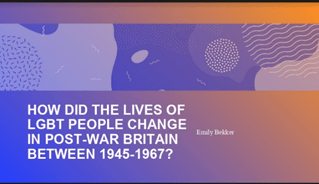
PGCE Historian Emily Bekker’s cover slide to an outstanding lesson she shared with the group

Turning to the afternoon session, Dr Evans set the cohort the task of creating their own LGBT+ lessons. Giving the PGCE students free reign to pick their period, lessons were created on Section 28, the development of Canal Street in Manchester and the treatment of LGBT+ Second World War personnel. Such lessons not only demonstrated the creativity of the trainees, but highlighted how complicated, messy and positively disrupting LGBT+ History can be. Emily Bekker’s lesson, for example, showed how during the Second World War the military authorities cared little for the sexuality of those within, but as soon as the war ended the spectre of institutionalised homophobia returned. Lessons such as Emily’s only serve to show pupils how flexible societies so-called norms are as well as shed light on an area completely ignored by the National Curriculum

On a personal note, Dr Evans’ session taught me more about LGBT+ History in a single day than almost 20 years of state education had. Dr Evans’ session highlighted how LGBT+ History can not only illuminate previously hidden histories, but also break down existing barriers. It is up to History teachers to be the vanguard of such change, however, and show how LGBT+ History can be successfully integrated to create a truly inclusive National Curriculum.

PGCE Historians work on decolonising the curriculum through the use of digital archives

On October 6th, PGCE Historians took part in a collaboration with the Maya Sharma, Collections Access Officer at the Ahmed Iqbal Ullah Race Relations Resource Centre, which is based in Manchester’s Central Library. Adam Cooke, Widening Participation Coordinator for The University of Manchester Libraries, also joined us to take part in a session that centred on locating and using archives to put ‘hidden histories’ at the centre of planning a historical enquiry.

Maya Sharma describes the session below:

‘Our organisation is named after Ahmed Iqbal Ullah, a boy of Bangladeshi heritage who was killed in racially motivated playground incident in Manchester. To this day, it’s shocking to think that a young boy was killed in the place where he should be safe to grow, develop knowledge, confidence and identity.  Our founders’ vision was for a library and archive that would not only have huge research value, but also be instrumental in celebrating cultures, combating racism and helping communities to tell their own stories. Ultimately, they hoped, this would prevent incidents like Ahmed’s murder.

Given our origins, I was delighted to contribute to this session. We strongly believe that anti-racist teaching is key to our vision. Being able to work with PGCE History trainees is the perfect opportunity for us to contribute to building their confidence to decolonise the classroom and curriculum, and to offer resources to do so.

In my session I gave a very brief introduction to the National Archives; trainees were then tasked with finding records to base lessons on. I was really impressed by how quickly they managed to find interesting records that would enable them to teach in decolonised ways – centring the often-marginalised voices, teaching the real legacy of colonialism, and challenging some of the dominant (and racist) discourses that are still perpetuated in some school teaching today. I felt confident that this cohort of trainees would do their best to make the National Curriculum work for everyone rather than tell a limited story.

I’m really looking forward to joining the trainees at a later point and have already had some volunteers to support the Ahmed Iqbal Ullah RACE Centre in our work. This dialogue between the Education department, the trainee History teachers and the AIU RACE Centre is a great example of a collaboration which should have a real impact on tomorrow’s teaching.’

A trainee’s eye view of the session with Emma Hollis, PGCE History

The PGCE History group’s seminar with Maya Sharma and Adam Cooke came as part of an extended examination of decolonisation and the representation of BAME histories in curriculum planning. It was a privilege to learn first-hand about the Ahmed Iqbal Ullah RACE Centre (my first time engaging with them) and to hear about the work they do within the community. As we hope to do for our students, it was incredibly useful to engage with a local resource on decolonisation and diversity to make these perspectives relevant to ourselves and our surroundings.

Maya described decolonisation not just as ‘putting in’ certain perspectives in a curriculum, but a process of dismantling structures within that curriculum and interrogating why certain histories have been suppressed and hidden. We explored the two notions of decolonising and diversifying History curricula and were able to identify limitations within the latter approach; in simply diversifying History curricula we run the risk of tokenism. Rather, we discussed the need to put BAME histories at the centre of our enquiry planning in order to create a curriculum that is decolonised.

Maya modelled the process of searching digital archives, and we followed this with group work in which we searched the National Archives catalogue for sources to base a historical enquiry on. WE were thrilled to identify brilliant sources such as Windrush passenger lists, bureaucratic documents from the British High Commission in Ghana, and a range of written and pictorial primary source material. We used these documents as the basis for a lesson planning activity focusing on colonial and migration histories, and began to build a collective source bank for our later teaching experience on placements. As a passionate advocate for the use of archives, Maya was an inspiring presence and we are looking forward to future collaboration with her on future projects.

As an Australian, having moved to the UK only a couple of months ago, I have developed a particular interest in the National Curriculum and was intrigued to find so many histories seemingly ignored within it. Australian histories don’t even feature in it- there is not a mention of my part of the southern hemisphere! Current debates about how and where to decolonise the curriculum seem interesting and timely.

I think it’s time that diverse histories, such as LGBT+ and BAME histories, take a more prominent role in the curriculum. After all, an inclusive reading of the past is essentially a rigorous and historically accurate reading of the past. In essence, inclusive History teaching is good History teaching. As a former Archival assistant I also know the incredible value of archives as the foundation of good, source-based history, and how archival materials can connect young people with distant pasts. I look forward to engaging more with the Ahmed Iqbal Ullah RACE Centre as the year progresses.’

Another Trainee’s Perspective from Julia Morton, PGCE Historian

‘2020, for various reasons, has been eye-opening to say the least. The murder of George Floyd on May 25th this year, as I’m sure everybody is aware, sparked mass protest across the country and brought the way history is taught in schools to the forefront of a wider debate regarding anti-racist activism and how Britain reflects on its own past. I, a woman from a White British background, have recognised throughout my education the racial inequalities of Britain from the period of the slave trade and abolition, yet when looking at the issue of modern racism as a student, we focussed on the 20th Century Civil Rights movement in the USA, rather than modern Britain. There has been a tendency in the British curriculum to focus lessons on anti-racism and racial inequality on these two topics, failing to address the racism and inequality that occurs in Britain today.

Maya Sharma, from the Ahmed Iqbal Ullah Centre, helped to cement the thought in my mind that anti-racism is an extremely important element of education, which young people should be receiving on a compulsory basis as part of the National Curriculum. The National Curriculum is too-often dominated by British triumphant narratives and an ignorance of non-white, non-western culture. Maya emphasised the importance of amplifying the voices of non-white people throughout our future teaching careers, not just through a lens of oppression and injustice, but a lens of rich culture, traditions, and individuals.

Through a dive into the online National Archive as a cohort, we recognised the importance of oral testimonies as a valuable type of source to lead a broad enquiry question. Oral testimonies do exactly what Maya recommended with regards to amplification of non-white voices. The decolonisation of the history curriculum in schools is a mighty task, but the sessions we have had through University have assured me it is something I am able to assist with.’

Design a site like this with WordPress.com
Get started